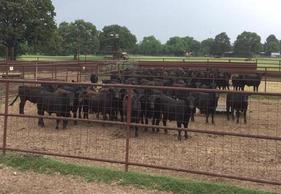
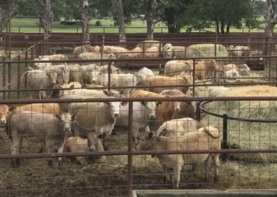
In order to maximize the benefits of your weaning and preconditioning your calves, we will designate a portion of the first sale of each month to feature weaned calves.
Minimum requirements:
1. Weaned at least 45 days.
2. Delivered to DLM prior to 5 p.m. on the Saturday preceding the 1st sale of each month (ie, December 1 for the December 3 sale). Cattle will be sold first in – first out.
Any vaccination program you follow will be announced as your cattle are presented (Buyers recommend vaccinations against respiratory disease.).
Whether you have 1 calf or 100, if they meet the minimum requirements they can be included in this featured segment of the sale – the more cattle offered the greater the buyers’ interest.
New Regulations for Buying and Selling Bulls: Texas Cattle Trichomoniasis (Trich) Program
Overview:
Trich is a venereal disease of cattle that causes infertility and abortions.
Trich is not a human health issue.
The focus of the program is breeding bulls as there is no cure for a bull once infected. The majority of infected cows will clear infection if they are given 120 - 159 days of sexual rest.
Effective April 1, 2009, breeding bulls entering Texas must be 24 months of age or younger and certified as a virgin or be tested negative for cattle Trich within 20 days prior to entry.
Effective January 1, 2010, the second phase of the program will address in state movement of breeding bulls. After January 1, 2010, breeding bulls in Texas must be certified as virgin bulls or tested negative prior to selling, loaning, exchanging, giving or otherwise changing possession of a breeding bull. No test or certification is required for bulls that are to be harvested.
For more information, contact your County AgriLife Extension office or Texas Animal Health commission at www.tahc.com or and Information Office at 1-800-550-8242 ext 710. Or you can come by our office and pickup an information sheet.
What is it Worth? - Adding Value to your Calves
Control Breeding Season:
Having uniformed calves that can run in groups of 5 +/- head will typically yield $3 - $5 more per hundred pounds.
Preconditioning Calves:
Especially in times of the year when the temperature fluctuates or is extreme, conditioned calves are worth more money.
Calves weaned 45+ days are less likely to get sick.
Calves vaccinated not only for black leg but also respiratory diseases are worth more money.
Steer calves will typically sell for more money than bull calves, especially weighing more than 500#.
We are seeing $5 - $6 discounts for 6 weight bull calves and $7 - $9 for 7 weights as compared to same quality steers.
Worming and mineral supplement - worming spring calf crop in June will typically yield around 20# additional gain by weaning. Mineral supplements will help convert feed and help health and appearance. Worming calves with dead/dull hair will be discounted.
Don't overfeed during weaning - Maintain a balance of diet that keeps calves growing and in good flesh but avoid excess fat and fulness.
Using data gathered by Oklahoma State University the value added by using these management practice has been:
Dehorn, deworm, castration vs. nonprocessed cutting bulls = $40 - $46 per head (we are seeing $55 - $63/head on 7 weight cattle).
Marketing uniform lots of at least 6 head = $5.35/cwt more than singles.
Polled/dehorned calves $3.70/cwt more.
Worming calves averages adding $11.55 per head through increase weight.
Very fleshy, full or tanked calves discounted $10 - $17/cwt.
Consignments being accepted for our 18th annual
"Bringing in the Green" Special Sale, Saturday, April 10, 2010.
To consign your cattle, please call Roland or Mickey at 940-627-5599
or you can contact them by email - dlmteam@aol.com
Texas Limousin Association "Texas Best" sale at Decatur Livestock Market, Saturday, Aprl 17, 2010. For more information regarding this sale, please contact Ralph Hawkins, Executive Secretary for TLA at 940-367-4633 or txlimo@aol.com.
Animal Based Agriculture Under Attack:
We were sickened to see on TV the recent incidents of starving donkeys, several of which had already died. Unfortunately this is one of the results of eliminating supervised horse harvesting plants in the US - excess inventory with no market outlet. The owner was in a trap. To sell the donkeys requires a coggins test by a vet that costs $25 - $35 and the donkeys might sell for $2 - $10 each on a good day. If he did not have the money to buy feed, it is doubtful that he can afford the $40 +/- lost to try and sell a donkey. Before the ban on horse harvesting and economic downturn a spotted Jenny would sell for $200 - $300 versus the $2 - $10 today.
Then on Channel 8 Night Line show this week, they showed the docking of tails and dehorning of dairy heifers in California - of course they showed it in the worse light with the heifers slipping down and lots of smoke from the dehorning.
During this week as we saw the terrible devastation and need of help for Haiti earthquake victims, the Humane Society had a series of dog and cat pictures as part of fundraising campaign. The implication was that the funds would provide shelter and care for these animals.
Coincidentally, I have received a summary of the Humane Society of the United States IRS filing. Some interesting facts from the filing:
The group collected over $80 million in contributions of which more than $24 million was spent on fundraising, ie 28 cents of every dollar goes out the back door to raise more money including $4 million to professional fundraisers and $4.2 million to a "lockbox" company to process receipts.
The group paid $30.9 million in salaries and other compensation in 2008 with 41 employees making at least $100 thousand a year and the CEO earning more than $250 thousand to run the animal rights "charity".
They provided approximately $2.3 million to a political campaign committee called "Californians for Humane Farms" to push for California's Proposition 2 initiative.
Not to worry - they did in fact give a little more than $450 thousand to organizations providing hands-on care of dogs and cats (less than 11% of what is paid the lockbox company to process receipts).
The agenda for the Humane Society of the United States and PETA is to stigmatize meat eaters and destroy animal based agriculture.
This information was collected from www.consumerfreedom.com on December 30, 2009.
Be informed:
A new source of updated information on the activities of the Humane Society of the United States (HSUS) is provided by the Center for Consumer Freedom (CCF).
A website - www.HumaneWatch.org - will provide facts as to how the nearly $100 million in animal contributions to HSUS is actually dispersed.
Hopefully this visibility will result in more than the less than half of one percent of their funds that actually gets down to the animal shelters.